Black and White Kittens for Sale in Singapore
Meet our current black-and-white British Shorthair kittens. See how crisp white markings reshape a dark round face, view real photos and book a private kitten viewing in Singapore.
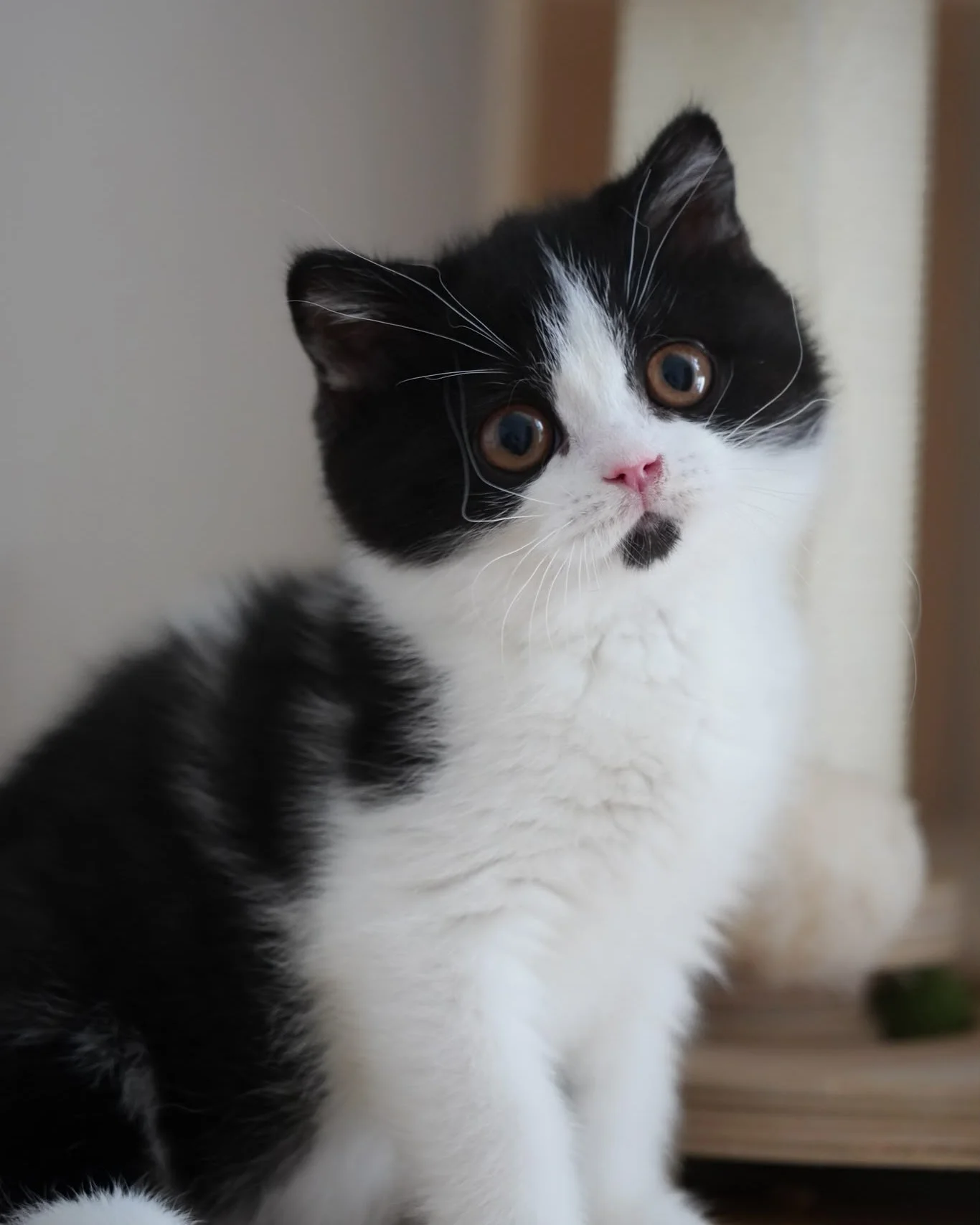
Meet Our Current Black and White Kittens
See real photos, breed, colour, sex and latest status. Open a profile for more photos, personality details and viewing information.
How Does a Kitten Become Black and White?
The black comes from dark pigment called eumelanin. The white is not a second pigment painted over it. Before birth, pigment-producing cells travel through the developing skin; where those cells are present, the fur can grow black, and where they do not arrive, the fur grows white. This is known as white spotting.
The amount and route of that white spotting create the finished design. It may stop at the toes and chest, climb into a white muzzle and blaze, or spread across most of the body while leaving colour on the head and tail. That is why “black and white” tells you the palette, but never the exact face you will meet.
What Does a Black-and-White Kitten Look and Feel Like?
Black and white has the clearest, most graphic contrast of NekoTown's colour families. It can look neat and formal when the white sits on the chest and paws, or cheeky and expressive when a blaze runs off-centre or a dark spot lands beside the mouth. The appeal is less about softness of colour and more about a face that is easy to recognise instantly.
On the black-and-white British Shorthairs we have welcomed, black can sit across the crown, ears and back while white opens the round face and continues through the muzzle and chest. The dense short coat keeps both colours looking full and clean, giving the kitten the appearance of a tiny ink drawing brought to life.
Bicolour, Tuxedo and Van: How the Words Differ
Bicolour is the broad formal term for a coloured coat with white. Tuxedo is an informal visual nickname, often used when a cat has a dark body with a white chest, belly or paws. Van describes a much whiter arrangement in which colour is concentrated mainly on the head and tail, sometimes with small body patches.
We may describe the same kitten as black and white when talking about colour, and as bicolour when talking about the pattern. The two descriptions complement each other: one tells you the palette, while the other explains how colour and white share the coat.
Why the White Markings Matter More Than Symmetry
A perfectly mirrored face is only one possible black-and-white look. Off-centre blazes, a single dark cheek or a small chin spot can be more memorable because they give the kitten a face that is instantly its own. CFA's British Shorthair standard prefers symmetry for show judging, but a family choosing a companion can simply decide which real pattern they enjoy looking at every day.
Compare the face first, then the chest, paws, back and tail. A close portrait may hide how much of the body is black, while a standing side view reveals the true colour balance.
How the British Shorthair Coat Holds the Contrast
British Shorthair fur is short and very dense. The black areas appear deep and solid because the coat stands away from the body, while the white areas look full rather than flat. The rounded cheeks and broad chest give large white markings more visual space than they would have on a narrow-faced breed.
As the kitten matures, the head and body become broader and the coat gains adult density. The boundary between black and white stays in place, but the same marking can look smaller once it is spread across a larger adult frame.
Black and White Compared with Calico and Grey Bicolour
Black and white uses one dark pigment colour plus white. Calico adds red patches, producing black, red and white on the same coat. Blue bicolour replaces black with its softer blue-grey dilute, so the contrast is gentler.
If you like a bold face and clean contrast, black and white is the strongest of the three. If you prefer more colour movement, calico adds warm red patches. If you prefer a quieter palette, the grey kitten page includes blue bicolour examples.
Photographing and Viewing a Black-and-White Coat
Phone cameras often expose for the white fur, causing detail to disappear from the black areas. Look for recent photos taken in soft daylight and compare at least one full-body view with one portrait. The black coat should still show texture rather than becoming a featureless dark shape.
In person, move around the kitten instead of judging one front view. The head may be evenly divided while the back carries a large black saddle, or the face may be asymmetrical while the body has a balanced distribution.
Black-and-White Kittens in a Singapore Home
Heat tolerance and grooming follow the breed and coat rather than the black-and-white palette. The British Shorthair's dense coat is the practical factor: regular combing removes loose hair, and a comfortably ventilated indoor home helps in Singapore's warm, humid climate.
Both halves of the coat reveal different everyday details. Pale loose hair is obvious on black fur; dust and tear staining are easier to notice on white fur. That contrast makes short, regular grooming especially useful.
Current Black and White Kitten Availability
The cards above show black-and-white kittens that are available now or arriving soon. Open a kitten's profile for recent photos and the latest availability. If none are shown, tell us how much white you prefer—from a small chest marking to a mostly white coat—and we can let you know whether a similar kitten is expected.
Meet a Black and White Kitten in Person
A private viewing lets you see the complete pattern, not just the most flattering angle. At 599 Geylang Road, you can compare the face, back, chest, paws and tail in ordinary light while also getting to know the kitten's individual behaviour.
Book a black-and-white kitten viewing or browse all available kittens in Singapore.
Black and White Kittens FAQ
Useful answers for buyers comparing black-and-white kittens in Singapore.