Before Buying a Cat in Singapore: A 10-Step Checklist for First-Time Buyers
Before buying a cat in Singapore, check your housing, the cattery’s AVS licence, the kitten’s health and identity records, the agreement, microchip and home setup—in the right order.
It is easy to begin with a kitten’s photo, colour or price. A more useful order is to first confirm that your home and household are ready, then understand the cattery and the individual kitten, review the records and agreement, prepare your home, and finally arrange the handover.
This guide is for people planning to buy a kitten in Singapore. You can use the same checklist with any cattery or pet shop—including NekoTown.
The 10 steps at a glance
| Step | What to do | What you should know before moving on |
|---|---|---|
| 1 | Confirm your housing, household and long-term plans | Your home permits cats and everyone understands the commitment |
| 2 | Decide what age, temperament and care needs suit you | Your choice goes beyond breed, colour and gender |
| 3 | Verify the cattery or pet shop’s AVS licence | The licence number, operating entity and address can be matched |
| 4 | Review the individual kitten’s information | The identity, health and daily-care records relate to that kitten |
| 5 | Meet the kitten and understand its environment | You can observe the kitten and ask practical questions |
| 6 | Understand what each document proves | Microchip, veterinary, pedigree and screening records are not interchangeable |
| 7 | Review the price, deposit, agreement and health terms | The written terms match what has been discussed |
| 8 | Prepare your home before collection | Windows, doors, hazards and essential resources are ready |
| 9 | Check every handover item | The kitten, microchip number, documents and next care dates match |
| 10 | Complete PALS, veterinary and settling-in arrangements | Ownership details are correct and a local care plan is in place |
1. Confirm your home and household are ready
How many cats can you keep?
Under the current Animal & Veterinary Service (AVS) rules:
- An HDB residential unit may generally keep up to two cats, as well as one dog of an HDB-approved breed.
- A private residence may generally keep up to three cats and/or dogs in total.
If you rent, check your tenancy agreement before bringing a kitten home. An AVS cat licence does not replace any permission required under your lease. Condo residents should also check the by-laws that apply to pets, common areas and nuisance management.
Discuss the practical arrangements
Agree on:
- who will feed the kitten, clean the litter boxes and provide daily play;
- whether anyone at home has allergies, asthma or other concerns;
- how children will interact with the kitten and respect its quiet spaces;
- who will provide care during travel, illness or a future move;
- how the household will manage routine and unexpected veterinary costs.
Once these arrangements are clear, it becomes much easier to assess which kitten genuinely fits your home.
2. Look beyond appearance to everyday compatibility
Breed pages are useful for understanding general size, coat and care tendencies. Each kitten, however, has its own temperament and daily habits.
When comparing kittens, consider:
- activity level and preferred style of interaction;
- confidence around unfamiliar people and environments;
- known experience with children or other pets;
- grooming needs associated with coat length and density;
- weight-management or mobility considerations;
- any ongoing medication, review, diet or care needs.
If you are still comparing breeds, explore our guides to the British Shorthair, British Longhair, Ragdoll and Munchkin. Use them to compare grooming, activity, weight management and health considerations, then ask about the individual kitten that interests you.
3. Verify the AVS licence and business details
AVS advises prospective owners to obtain pets through legal sources and publishes a list of licensed pet shops. A practical check is to:
- note the complete AVS licence number;
- find it in the official AVS list;
- compare the operating entity and address;
- clarify any differences before proceeding.
NekoTown’s published details
We publish NekoTown’s licence number, AS25E00023, and our address, 599 Geylang Road, on our website. The AVS licensed pet shop list records the same licence number under SINMA GLOBAL PTE. LTD. at 599 Geylang Road.
The official list confirms the licence, operating entity and address. Information about a particular kitten—such as health records, temperament observations and handover arrangements—can then be reviewed separately during the selection process.
4. Build a record for each kitten you are considering
Rather than comparing adverts alone, create a simple information sheet for each shortlisted kitten.
| Area | What to review | Why it helps |
|---|---|---|
| Identity | Date of birth, sex, colour, origin and microchip number | Connects the kitten to its records |
| Current condition | Weight, appetite, toileting, activity and recent observations | Gives you a current baseline |
| Vaccination | Dates, product details or stickers, and administering vet | Helps your local vet plan the next step |
| Parasite care | Product and treatment date | Reduces unnecessary repetition or gaps |
| Veterinary checks | Date, examination findings and follow-up advice | Explains what has already been assessed |
| Parent and pedigree records | Parent identities, registration and applicable screening | Places lineage and screening in context |
| Daily routine | Current food, litter, feeding and grooming routine | Supports a smoother home transition |
| Handover plan | Collection date, sterilisation status and next care dates | Helps you prepare accurately |
You can begin with our available kittens in Singapore. Individual profiles may show age, origin, feeding, vaccination and record images. If you would like to see more of the corresponding records, let us know when you enquire or book a visit.
5. Meet the kitten and ask about its daily life
Online profiles make shortlisting easier. An in-person interaction adds useful information about the kitten’s present behaviour, routine and environment.
During a visit, observe:
- whether the kitten stands and moves comfortably;
- whether the eyes, nose and ears appear free from excessive discharge;
- whether the coat is clean, without obvious hair loss or persistent scratching;
- the kitten’s breathing, alertness and activity;
- how it responds to unfamiliar people at its own pace;
- whether the team can explain its food, litter, personality, health records and next care steps;
- whether the environment provides clean water, rest, hiding and appropriate activity areas.
Kittens respond differently to new people and settings. A visit helps you understand what you see that day, while daily observations from the people caring for the kitten add a broader view.
At NekoTown, we offer appointment-based kitten interactions. You can observe the kitten in our interaction space and ask about temperament, routines, vaccination records and home preparation. When you book a kitten viewing, tell us what matters most to your household so we can help you assess compatibility.
6. Understand what each document tells you
Documents are most useful when their purpose is clear.
AVS licence
This identifies the relevant licensed business activity and premises. Individual kitten information is covered by separate records.
Microchip record
A microchip gives the kitten a scannable identity number. It is not GPS, and the chip alone does not complete the AVS cat-licensing or licensee-transfer process.
Vaccination and veterinary records
These record what was administered or examined on a particular date. Your local veterinarian can use them to decide what is next for that kitten.
Pedigree or association registration
These documents record identity and lineage within a registry. They serve a different purpose from government licensing and health screening.
Parent or kitten screening reports
A screening report applies to the identified sample and the tests listed in that report. Check:
- whether it relates to the sire, dam or kitten;
- how the identity is linked;
- whether the method was DNA testing, imaging, clinical examination or another assessment;
- which finding was reported;
- which screening is relevant to that breed and parent combination.
We explain NekoTown’s review of breeder identity, parent records, microchips, vaccinations, veterinary checks, import preparation and breed-relevant information in How NekoTown Selects Breeders and Kittens. The documents that apply can differ by breed, parent combination and kitten, so we will take you through the relevant records for the kitten you are considering.
7. Review the price, deposit and written agreement
A clear purchase discussion should cover more than the headline price:
- the kitten’s purchase price;
- deposit amount, reservation period and refund conditions;
- vaccinations, microchip, cat licence, sterilisation, examinations or import items included;
- when pedigree, parent screening or other records will be supplied;
- any carrier, food, litter or starter items included;
- arrangements if collection is delayed;
- when and how to report a health concern;
- the definitions, time limits and requirements in any health or hereditary condition terms;
- the available arrangements if a family can no longer keep the cat.
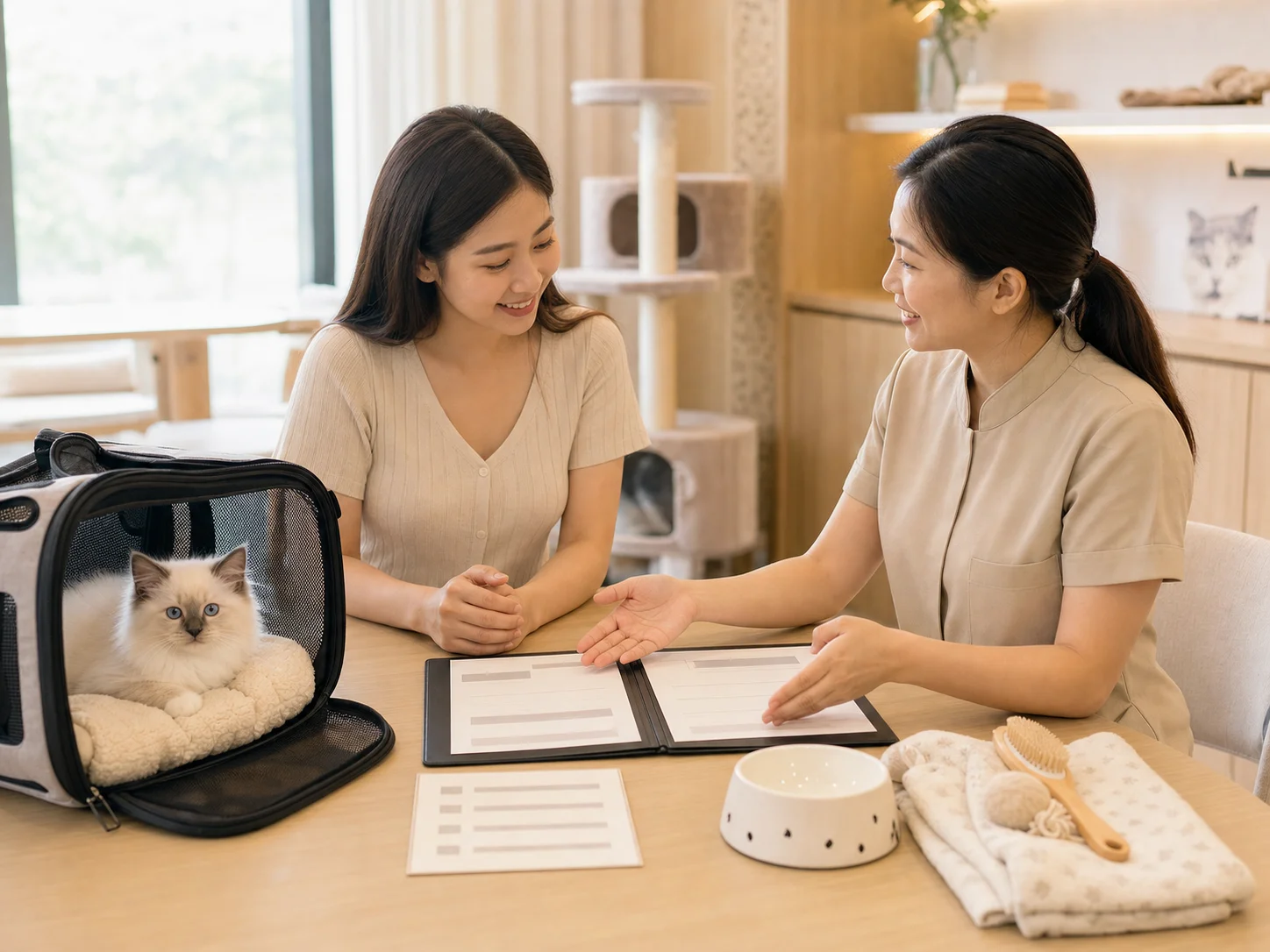
Important terms should appear in the purchase agreement or its attachments. At NekoTown, our process includes a purchase agreement, health terms and after-sales support. The signed version sets out the terms that apply to your kitten, and our team can take you through it before you confirm.
8. Prepare your home before the kitten arrives
AVS requires cat owners to provide a safe environment and take reasonable steps to prevent cats from roaming or falling from height.
Check:
- windows, gates, balcony openings, service yards and bathroom ventilation windows;
- whether mesh, grilles or screens are securely fixed;
- how the main door will be managed when people enter or leave;
- wires, medicines, cleaning products, string, rubber bands and small objects;
- whether accessible plants are safe for cats;
- washing machines, dryers, cupboards and spaces behind furniture.
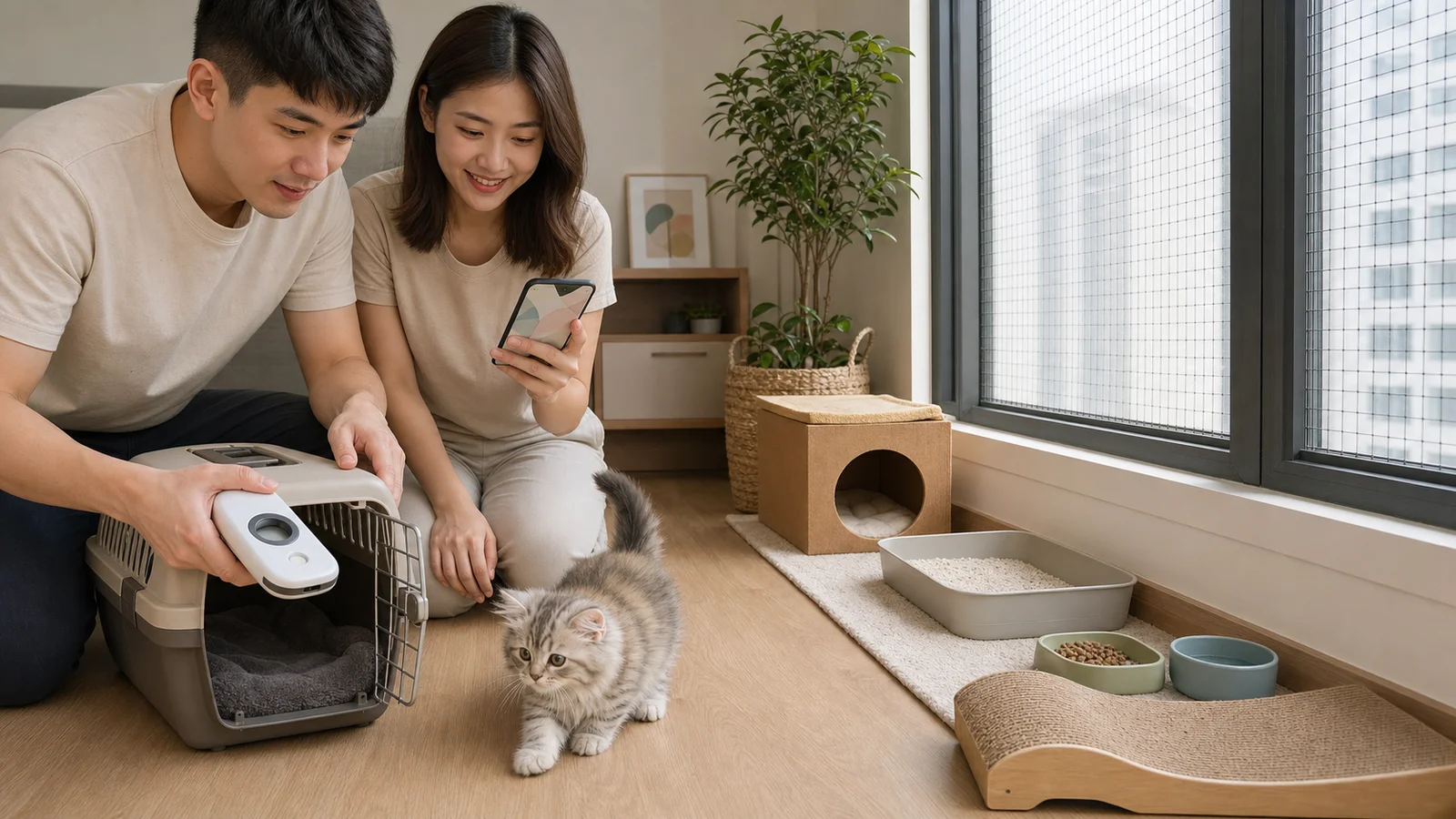
Prepare the essentials:
- the complete, age-appropriate food currently fed to the kitten;
- the familiar litter and an accessible litter tray;
- food and water bowls placed away from the litter area;
- a secure carrier;
- scratching surfaces, a hiding place and a quiet resting area;
- safe interactive toys;
- one calm starter room for the first few days.
If your handover includes a starter kit, you can use it to maintain familiar food, litter and routines. Prepare a practical initial quantity, then add items as you learn the kitten’s preferences.
9. Check the handover file and next dates
On collection day, confirm:
- the kitten matches the agreement, profile and microchip number;
- the chip can be scanned and matches the records;
- vaccination, parasite, veterinary, import and sterilisation information is included where applicable;
- pedigree and parent documents can be connected to the kitten;
- current food, feeding amount, litter and routine are written down;
- the next vaccination, review, parasite treatment or sterilisation date is clear;
- both parties have the agreement and attachments;
- the PALS application or licensee transfer process is understood;
- the emergency contact and reporting process is saved;
- the carrier is secure and well ventilated.
If the kitten’s condition on collection day differs materially from the earlier information—for example, marked lethargy, breathing difficulty, persistent diarrhoea or significant discharge—a veterinary assessment can help determine the most suitable handover arrangement.
10. Complete PALS and give the kitten time to settle
Cat-licensing sequence
- Confirm the microchip number.
- Confirm that the microchip information reflects the new owner.
- Complete the free online Pet Ownership Course if you are a first-time applicant.
- Apply for the cat licence or accept the licensee transfer through PALS.
- Check the licensee, address, kitten and sterilisation details.
As at 27 July 2026, cat licences remain free until 31 August 2026. From 1 September 2026, cat-licensing fees apply, and keeping an unlicensed pet cat becomes an offence.
For the first three cats and/or dogs, AVS currently lists a S$35 one-time licence for each sterilised animal. Periodic options are also available, while unsterilised pets have higher periodic fees. Check the AVS page again when applying, as fees and processes can change.
We can help prepare and explain the relevant NekoTown handover information. Once the process is completed, log in to PALS to confirm the licensee, address and kitten details.
The first few days at home
- Start in a calm, secure room.
- Continue the familiar food and litter.
- Let the kitten leave the carrier at its own pace.
- Monitor eating, drinking, urination, stool and general alertness.
- Introduce food changes, bathing and resident pets gradually.
- Arrange a local veterinary visit based on the handover records and agreement.
If your kitten develops breathing difficulty, cannot stand, persistently refuses food or water, repeatedly vomits or has diarrhoea, or strains without passing urine, contact a veterinarian directly and let us know promptly so we can review the handover information and next arrangements with you.
Details worth clarifying before you confirm
Ask for more information when:
- the AVS licence, address, operating entity or payment details need clarification;
- the in-person viewing or live update arrangements are unclear;
- the agreement, deposit conditions or included items have not yet been provided;
- the microchip number, vaccination record, date of birth or profile do not correspond;
- pedigree or parent information is described without the supporting document;
- the subject or scope of a screening report is unclear;
- health, temperament or after-sales terms need a clearer written definition;
- the kitten’s current condition differs from the earlier information.
These are practical questions. A clear answer helps both the family and the cattery prepare for a smoother handover.
How to use this checklist at NekoTown
Begin by browsing our current available kittens and shortlisting two or three that may suit your household. Read about how we review breeders and kitten records, note the information you would like to discuss, and book an interaction.
During your visit, we can go through:
- the kitten’s microchip, vaccination and veterinary records;
- parent identities and the information relevant to that breed;
- current food, litter, activity and interaction style;
- price inclusions, collection timing and next care dates;
- the purchase agreement and health terms that apply.
With the online profile, in-person interaction and written information considered together, you can choose a kitten with a clearer understanding of both the individual cat and the responsibilities ahead.
Frequently asked questions
How should I verify a kitten seller in Singapore?
Use the AVS licensed pet shop list to check the licence number, operating entity and address. Then review the identity, veterinary, microchip and agreement information for the individual kitten.
What do an AVS licence and a kitten’s health records each tell me?
The AVS licence identifies the relevant licensed business activity. The kitten’s health is considered through its veterinary, vaccination, microchip, parent and other applicable records.
Is a pedigree certificate the same as a genetic screening report?
No. A pedigree certificate records identity and lineage within a registry. A screening report records the result of specific tests on an identified sample.
Can a viewing tell me exactly what a kitten’s adult personality will be?
A viewing helps you observe how the kitten responds that day. Combine it with the kitten’s daily history and allow for the changes that come with travel and a new home.
What should I review before paying a kitten deposit?
Confirm the business licence and individual kitten records, then read the purchase agreement. Pay particular attention to deposit conditions, included items, health terms, reporting requirements, support periods and collection date.
Does a microchip mean the kitten is already licensed?
No. The microchip provides the identity number required for licensing. The cat licence still needs to be applied for or transferred through PALS.
Can I interact with a kitten at NekoTown before deciding?
Yes. Browse our available kittens online and book an appointment to meet them. Our team can explain each kitten’s personality observations, routine, available records and home preparation.
When should a newly purchased kitten see a veterinarian?
Arrange a local veterinary visit based on the handover record, the kitten’s condition and the purchase agreement. Seek prompt veterinary attention for breathing difficulty, straining without passing urine, persistent refusal of food or water, repeated vomiting or marked weakness.