Cat Body Language and Meow Meanings: A Singapore Owner’s Guide
Learn what your cat’s tail, ears, eyes, posture, purrs and meows may mean, plus how to spot stress, pain and urgent warning signs.
A cat meowing beside an empty bowl is often easy to understand. A long yowl in the corridor at 3am has many more possibilities. Your cat may be looking for you, asking for access to a room, reacting to something outside, carrying unused energy into the night, or experiencing a physical change that deserves veterinary attention.
Cats communicate through combinations. Tail position, ear direction, eyes, whiskers, posture, muscle tension, voice, location and timing all contribute. The most useful comparison is personal: what is normal for this cat, and what has changed today?
This guide gives Singapore cat owners a repeatable way to read those signals. It covers relaxed social behaviour, play, uncertainty, overstimulation, defensive communication and possible illness, with practical responses for each.
Start with this four-part method
Whenever your cat changes posture or makes a sound, read it in this order:
- Baseline: Is this cat usually chatty or quiet? How does the tail normally move? How much touch does the cat usually enjoy?
- Context: Did the behaviour happen before a meal, during play, at a window, when someone arrived, inside a carrier or in the litter tray?
- Signal cluster: Look at the ears, eyes, whiskers, tail, muscles, weight distribution, voice and available escape route together.
- Change over time: Has the frequency, volume, movement, appetite, activity, toileting or sleep pattern changed?
One signal suggests a possibility. Several signals pointing in the same direction create a clearer reading.
Dilated pupils are a good example. Low light enlarges pupils naturally. Play, excitement, fear, pain, medication and some eye or neurological conditions can also affect them. A crouched body, sideways ears, tucked tail and search for cover make uncertainty or fear more likely. Forward ears, a toy-focused gaze and a ready-to-pounce posture fit play more closely.
Quick cat body language chart
| Possible state | Common body signals | Sounds you may hear | A useful response |
|---|---|---|---|
| Relaxed and social | Loose muscles, natural ears, soft eyes, upright or loosely resting tail | Short meow, trill, soft purr, or silence | Keep your voice and movements gentle and let the cat choose the contact |
| Playful and focused | Low hunting crouch, rear-end wiggle, ears towards the target, moving tail tip | Short calls, chirps or chattering | Offer a wand toy and allow a complete chase-and-catch sequence |
| Unsure or fearful | Body made smaller, ears sideways or back, tail held close, large pupils, attention on an exit | Silence, brief meows, low sounds | Reduce movement and noise, then provide distance, cover and a clear route away |
| Overstimulated or frustrated | Growing muscle tension, rippling skin, faster tail sweeps or thumps, ears turning sideways, head turning towards touch | Low meow, brief protest sound or grumble | Pause contact and allow a short reset |
| Highly defensive | Rigid body, flattened ears, raised fur, arched or compressed posture, intense focus on the perceived threat | Hiss, growl, spit or shriek | Stop approaching, increase distance and keep the retreat route open |
| Painful or unwell | Hunched or tense posture, low head, narrowed eyes, reduced movement, hiding, appetite or grooming change | Unusual purring, vocalising when touched, persistent meowing or yowling, or silence | Record the change and contact a veterinarian; breathing and urinary warning signs need emergency care |
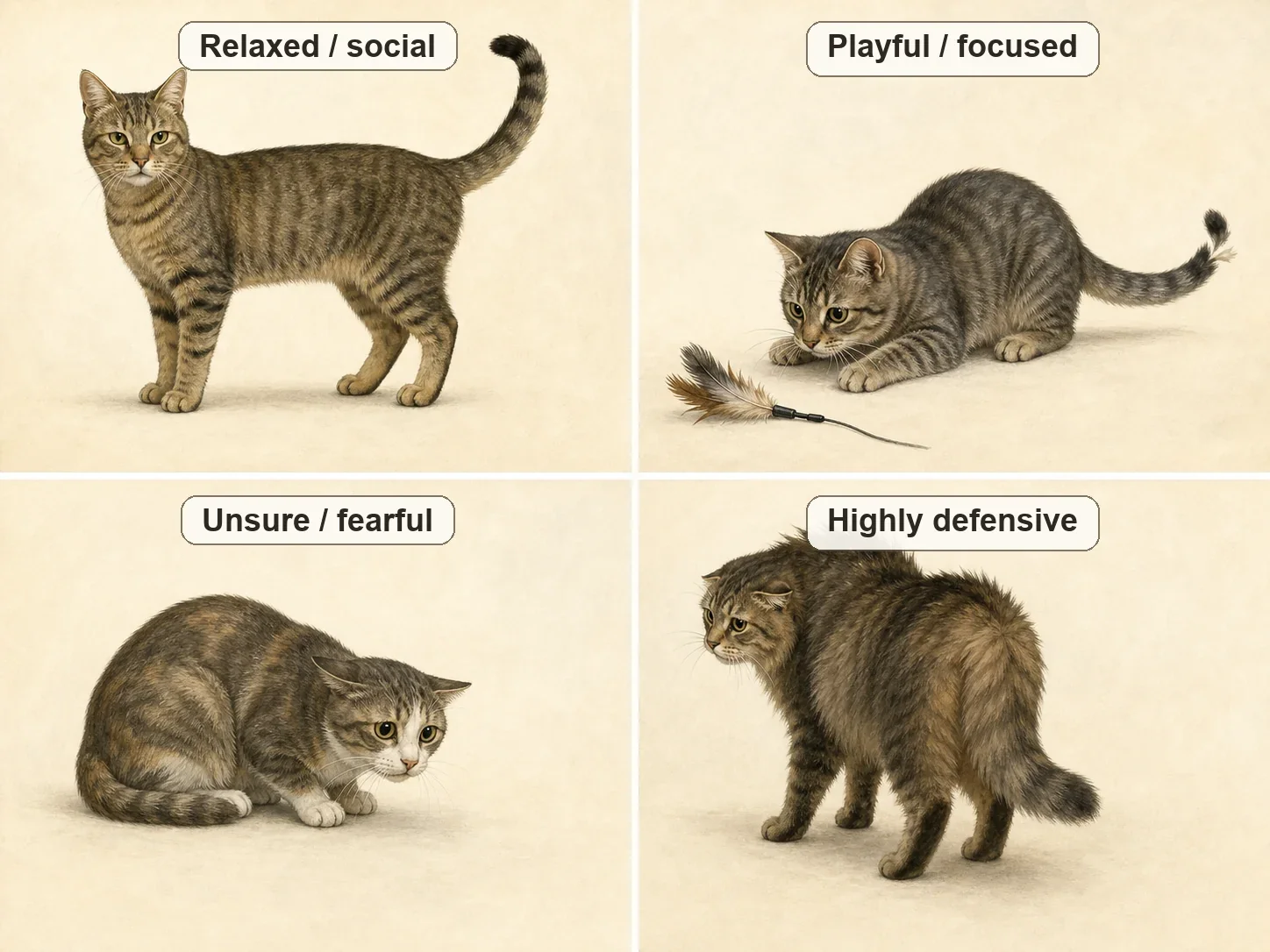
What your cat’s tail may be saying
Tail held upright
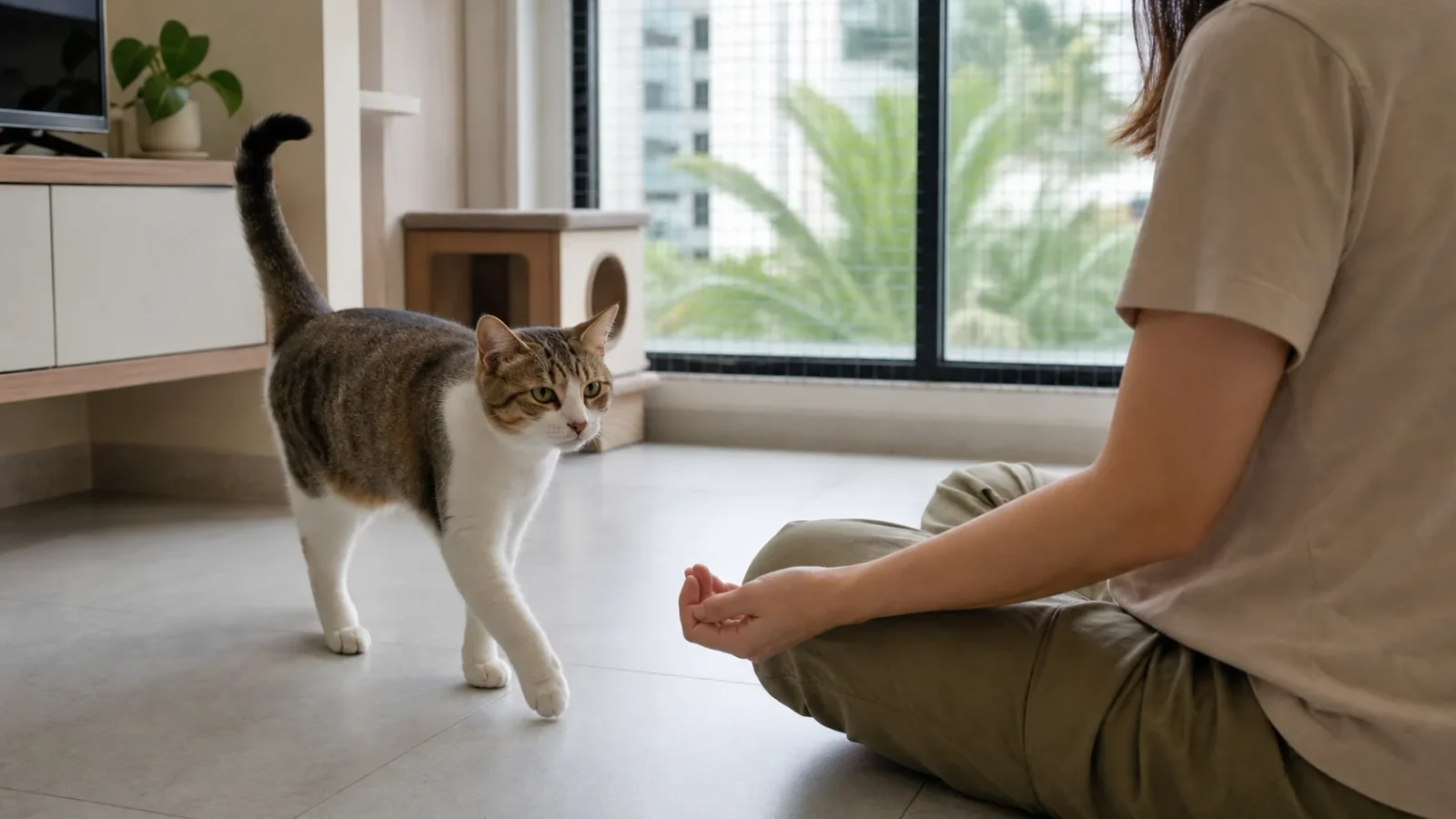
A cat approaching with a loose body and an upright tail, sometimes with a gentle curve at the tip, is commonly making a friendly and confident approach. The cat may be preparing to greet, rub against you or join an interaction.
Give the cat time to complete the approach. A low relaxed hand or soft verbal greeting preserves its choice around distance and touch.
Tail wrapped around a person or another cat
A tail curling around your leg or the body of a familiar cat often appears during friendly social contact. Facial rubbing, a soft gaze and an easy walking pace make the social reading clearer.
Small movements at the tail tip
A moving tail tip can accompany close attention, light excitement or a developing change in mood. Look at the target. A cat watching a toy or bird is in a different context from a cat receiving repeated strokes along the back.
Fast swishing or forceful thumping
Large sweeps and hard tail thumps usually indicate rising arousal. During petting, that change is a useful cue to pause. During hunting-style play, the cat may still be concentrating on the next pounce.
Tail held close or tucked underneath
Holding the tail tightly against the body makes the cat’s outline smaller and often accompanies uncertainty, fear or physical protection. Reduce the surrounding stimulation and leave a quiet path towards the cat’s hiding place.
Tail and body fur standing on end
Raised fur is called piloerection. It can follow a sudden fright or appear during intense arousal and defensive readiness. The cat needs more distance and an obvious way to retreat.
How the ears, eyes, whiskers and face work together
Ears forward or turning naturally
Naturally upright ears can accompany relaxation and interest. Each ear can also rotate towards a sound, so a brief change may simply show that the cat is gathering information.
Ears rotated sideways
Sideways ears, sometimes called “airplane ears”, are common during uncertainty, tension, frustration or overstimulation. A stiffening body and increasingly active tail suggest that an interaction is reaching its comfortable limit.
Ears flattened or held low
Low, flattened ears can accompany strong fear, defensive behaviour or pain. Give the cat space and look for related physical changes such as limping, reduced appetite, guarding a body area or reluctance to move.
Dilated pupils
Darkness enlarges the pupils. In bright conditions, large pupils can also accompany play, surprise, excitement, stress, pain or a health issue. Lighting, symmetry and the rest of the cat’s body provide the useful context.
Markedly unequal pupils, cloudiness, redness, discharge or persistent squinting call for veterinary advice.
Soft eyes and slow blinking
In two experiments on cat–human communication, cats showed more eye-narrowing movements after their owners slow-blinked. They were also more likely to approach an unfamiliar experimenter after a slow-blink interaction than after a neutral expression. The results suggest that slow blinking may take part in positive cat–human communication.
You can soften your gaze, close your eyes slowly and open them again from a comfortable distance. The cat can respond, approach, remain where it is or leave.
Whiskers resting, forward or pulled back
Relaxed whiskers usually sit in a natural fan. They may move forward during hunting, close investigation or intense attention, and closer to the cheeks during fear.
Whisker position also features in structured pain assessment. Read it with the eyes, muzzle tension, ear position, head height and the cat’s wider behaviour.
Posture and touch: commonly misread signals
Showing the belly
A cat lying on its side or back with loose muscles and naturally resting limbs may feel secure in the environment. Preference around belly touch remains individual. Starting with familiar areas such as the cheeks or chin gives the cat an easier way to show what it enjoys.
A defensive cat may also roll partly onto its side or back, placing all four paws in a position to protect itself. The body is usually more tense, the ears lower, the pupils larger and the gaze fixed on the approaching person or animal.
The “cat loaf”
The loaf position, with paws tucked under the body, can be an ordinary resting pose. A comfortable cat usually has a soft face, natural weight distribution and an easy relationship with the surrounding space.
A cat experiencing pain may also sit tightly hunched with a low head and narrowed eyes. Appetite, movement, breathing, toileting and normal daily activity help complete the assessment.
Kneading
Alternating pressure with the front paws is called kneading. The behaviour begins in kittenhood and often appears during relaxation, settling to sleep or self-soothing. Some cats purr or drool lightly at the same time.
A sudden increase in saliva, unpleasant mouth odour or difficulty eating belongs in an oral-health review.
Head bunting and facial rubbing
Pressing the forehead or cheeks against people and objects is often known as bunting or facial rubbing. It commonly appears in friendly interactions and also deposits familiar scent. The AAFP and ISFM environmental guidelines describe facial and body rubbing as part of the way cats maintain the scent profile of their core living area.
Hiding
Hiding can provide ordinary rest and a sense of safety. It can also accompany fear, stress or illness. Baseline and change provide the distinction: a cat that sleeps in the same cardboard box every afternoon presents a different picture from a usually social cat that suddenly remains hidden all day.
Turning or biting during petting
Many cats show a rising series of signals before ending contact. Early clues may include a faster tail, rippling skin along the back, ears rotating sideways, growing body tension, a head turn towards the hand or a sudden change in purring.
Pausing at that stage allows the cat to end the interaction with a small signal.
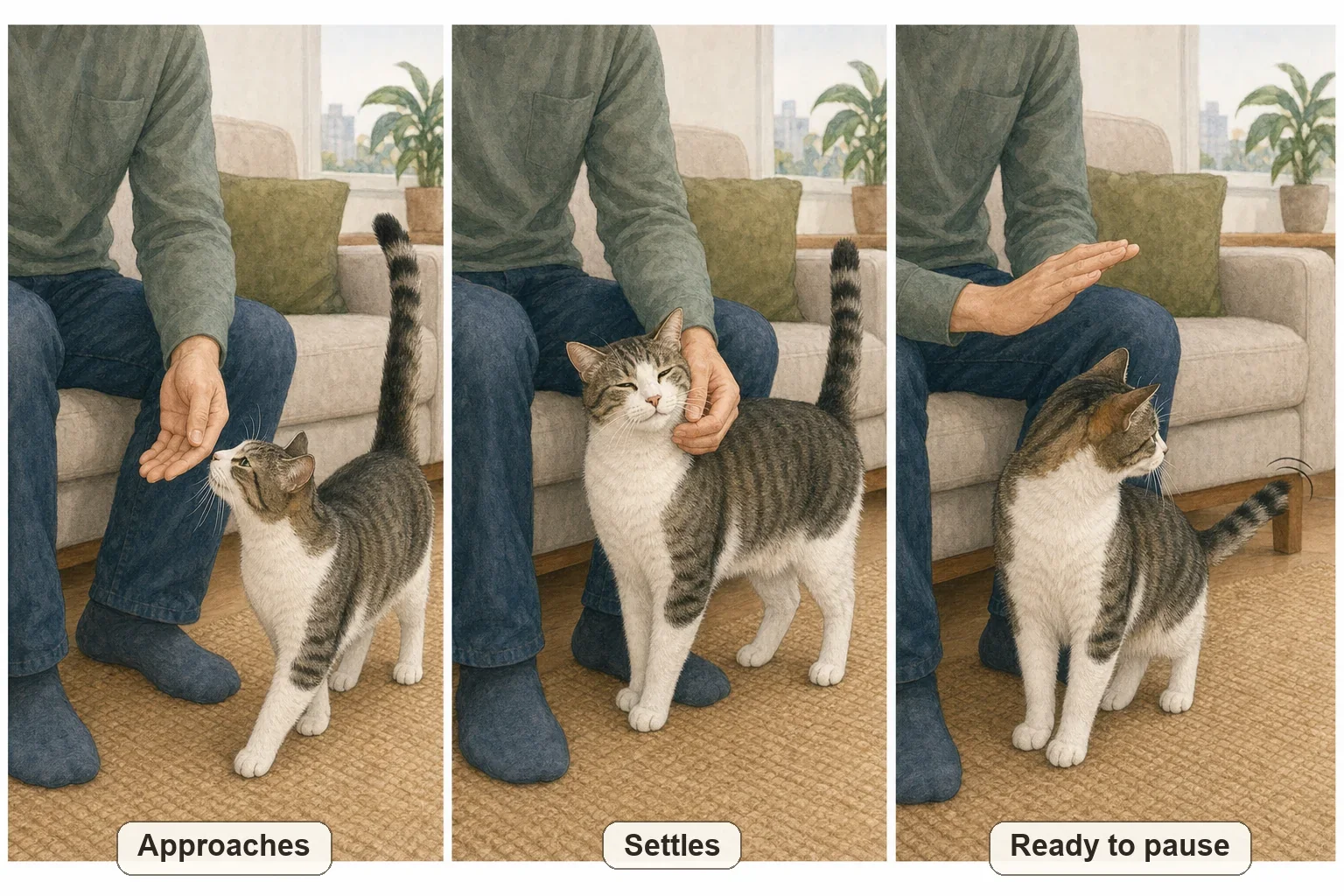
Cat sounds and what they may mean
The everyday meow
Adult cats use meowing mainly in interactions with people. A meow can accompany a greeting, waiting for food, an invitation to play, a request for access, a search for company or frustration.
In a study involving 225 adult listeners, participants heard meows recorded while cats waited for food, experienced isolation or were brushed. Fewer than half could correctly identify the context overall. Cat ownership and empathy helped with some recordings, yet a single sound still gave listeners limited precise information.
Your knowledge of the individual cat, its body language and the immediate situation makes the sound more useful.
| Sound and situation | What to observe | A useful response |
|---|---|---|
| One short meow while approaching | Upright tail, loose body, recent separation | Answer softly and allow the cat to approach |
| Repeated meows beside the food area | Meal timing, actual food intake, weight and appetite trend | Follow the feeding schedule and record intake |
| Meowing beside a door | Usual access, people or resources beyond it, learned door-opening routine | Check the need and keep the household rule consistent |
| Vocalising when a toy appears | Hunting posture, ears towards the toy and tail movement | Offer a short interactive play session with a catch at the end |
| Meowing in a carrier or unfamiliar place | Crouching, drooling, breathing, pupil size and attempts to hide | Reduce sensory load and add familiar scent and partial cover |
| Crying in the litter tray | Repeated visits, straining, only drops of urine or no urine | Contact an emergency veterinarian immediately |
Trills and chirrups
A trill or chirrup is usually a rising sound made with the mouth closed or partly closed. It often appears during greetings, requests for attention or invitations to follow. Mother cats also use related calls with kittens.
When a cat trills, walks away and looks back, see whether it is leading you towards food, a toy, a door or another point of interest.
Chattering at birds
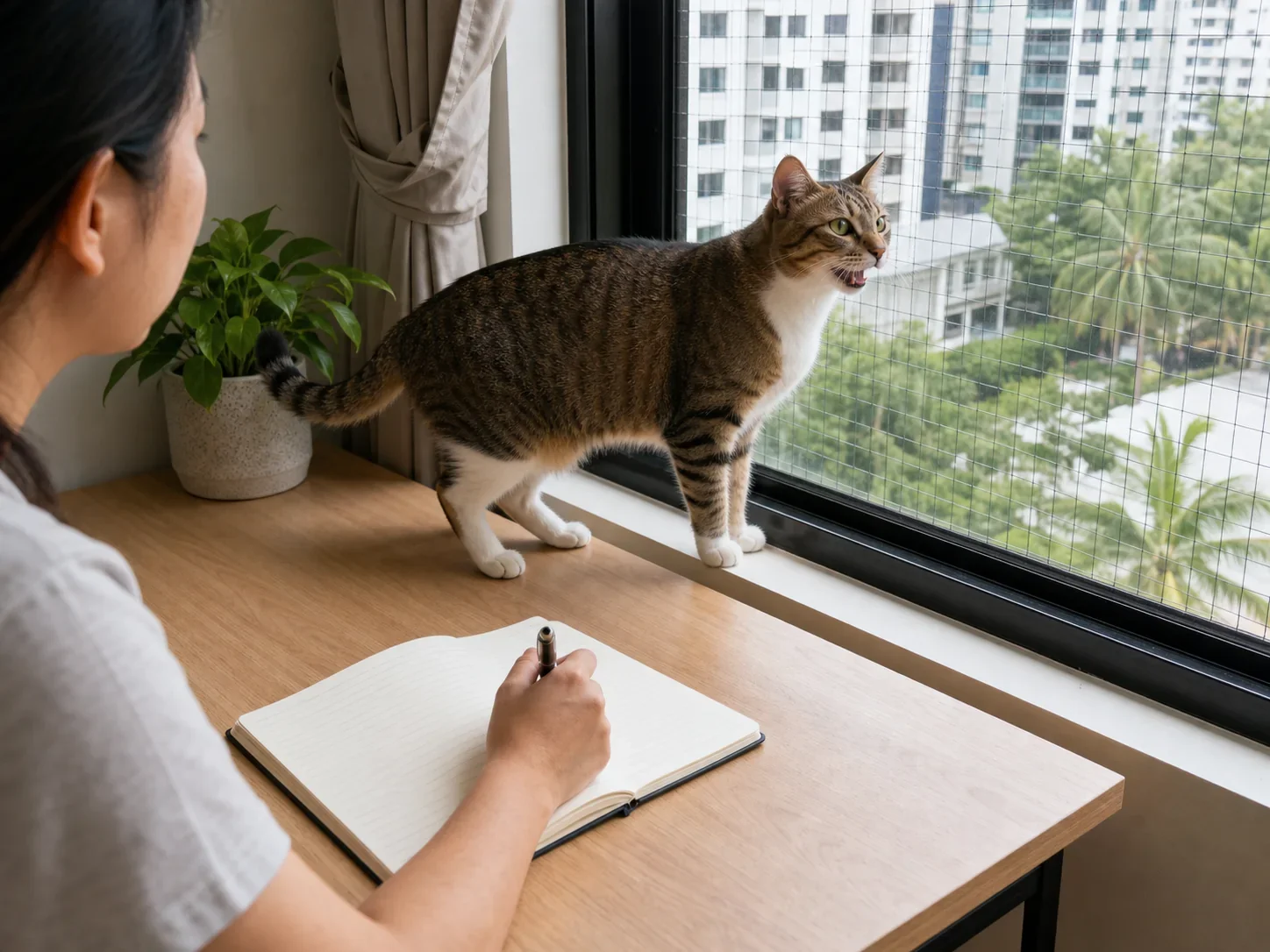
Chattering often includes rapid jaw movements and appears when a cat is focused on a bird or another potential prey animal through the window. Hunting excitement, concentration and frustration at an unreachable target may all contribute.
A secure viewing place, the option to move behind a partial screen and a later hunting-style play session can support this normal behavioural sequence.
Purring
Purring commonly accompanies relaxed social contact, rest, kneading and care of kittens. It can also occur during fear, illness or pain.
A loose body, soft face, normal eating and normal activity support a comfortable context. A tense or hunched posture, appetite loss, reduced movement or abnormal breathing shifts attention towards health.
Hissing, growling and spitting
Hissing, growling and spitting usually create distance when a cat feels threatened, frightened, painful or trapped. They communicate a clear boundary.
Stop the approach, keep the exit open and move children or other pets away from the immediate area. After the cat recovers, review the trigger, the environment, resource access and possible health changes.
Yowling, howling and caterwauling
These sounds are generally longer and louder than an everyday meow. An unsterilised cat may vocalise during mating or territorial activity. Pain, anxiety, disorientation, sensory change and illness can also produce yowling.
A senior cat that suddenly vocalises more at night, especially alongside weight loss, increased appetite or thirst, altered sleep, disorientation, staring at walls or litter changes, deserves a full veterinary assessment. Hyperthyroidism, hypertension, kidney disease, pain, vision or hearing change and cognitive dysfunction are among the possibilities a veterinarian may investigate.
Seven common communication situations in Singapore homes
1. Waking the household before breakfast
Consistent meal times, an automatic feeder or part of the evening ration in a puzzle feeder can weaken the connection between waking a person and receiving food.
Track the total daily intake and body weight. A sudden rise in appetite accompanied by weight loss or increased thirst belongs in a veterinary assessment.
2. Meowing outside a bedroom at night
Review the cat’s daytime sleep, evening play, access rules and the resources behind the closed door. A chase-and-catch play session followed by a small meal before bed can create a more settled routine. Consistency across the household helps the cat learn what happens next.
3. Chattering at birds through the window
This is a common hunting-related response. Singapore homes need secure mesh, grilles, screens or another reliable barrier at windows. Add a stable elevated viewing spot, wand-toy play and food-search activities indoors.
Where outdoor animals keep the cat highly aroused, a partial visual screen gives it a choice between watching and withdrawing.
4. Swishing the tail and turning during petting
Record the areas and approximate duration the cat finds comfortable. Pause at the early signal and make the next interaction shorter. Letting the cat return to restart contact creates a clear and predictable boundary.
5. Hiding after arriving in a new home
A new home brings unfamiliar sounds, scents, people and territory. Begin with a quiet settling room containing hiding places, food, water, litter and a scratching surface, then expand access at the cat’s pace.
Our guide to how kitten socialisation shapes confidence explains how early experience and the settling environment can affect responses to people, handling and household sounds.
6. Two cats staring at or blocking one another
Tension in multi-cat homes can be quiet. One cat may block a corridor, watch a litter tray, guard food or water, follow the other cat, or gradually reduce the other cat’s usable space.
Separate food, water, toileting, resting, scratching and elevated resources, with more than one travel route through important areas. Persistent conflict calls for a health check followed by assessment from a suitably qualified feline behaviour professional.
7. Meeting a community cat downstairs
Singapore’s Animal & Veterinary Service advises people to remain calm, keep a respectful distance and let a community cat approach at its own pace. Closely supervise children and keep movement and voices gentle.
A cat that moves away, crouches, turns its ears back, holds its tail close, hisses or fixes attention on an exit needs more space.
Build a communication diary for repeated meowing
For a repeated sound, a one- or two-week record often reveals more than the sound alone.
| What to record | Example |
|---|---|
| Time | 5.45am, 20 minutes before breakfast |
| Location | Bedroom door, food area, window or litter tray |
| What happened immediately before | Person woke, door closed, community cat appeared, petting ended |
| Sound | Three short meows, long yowl, trill or hiss |
| Body signals | Upright tail, sideways ears, crouching or pacing |
| Your response | Food, access, play, pause in contact or veterinary visit |
| What happened next | Settled, continued calling, ate, urinated or hid |
| Physical changes | Food, water, weight, toileting, activity and grooming |
The pattern can help you adjust the environment and gives a veterinarian or behaviour professional a clearer history. Short videos are useful when filmed from a safe distance and accompanied by the time and context.
When body language or vocalisation needs veterinary care
Contact an emergency veterinarian immediately
- open-mouth breathing, visible breathing effort, strong abdominal movement, blue-tinged gums or sudden inability to breathe normally;
- repeated litter-tray visits, urinary straining, distress cries and only a few drops of urine or no urine, especially in a male cat;
- collapse, seizures, inability to stand or sudden profound weakness;
- severe trauma, uncontrolled bleeding or suspected poisoning.
Urethral obstruction can become life-threatening rapidly. Straining and crying in the litter tray may resemble constipation to an observer. Little or no urine makes it an emergency.
Arrange a veterinary examination promptly
- a sudden change in the frequency, pitch, volume or timing of vocalisation;
- persistent hiding in a usually social cat;
- changes in appetite, thirst, weight, grooming, toileting or activity;
- vocalising, turning, biting or guarding an area when touched;
- persistent squinting, low ears, muzzle tension or a lower head position;
- night yowling, disorientation, staring or altered sleep in a senior cat.
The Feline Grimace Scale, developed and validated by researchers at the Université de Montréal, assesses five facial action units: ear position, orbital tightening, muzzle tension, whisker change and head position. It provides a structured way to observe facial changes associated with acute pain. A complete assessment also includes behaviour, history, physical examination and veterinary judgement.
How to respond without adding pressure
Relaxed or friendly approach
Turn your body slightly sideways, move slowly and keep your voice soft. Let the cat complete the final part of the approach. A slow blink can serve as a low-pressure invitation, with the response left to the cat.
Play and hunting excitement
Channel the energy into a wand toy, a toy the cat can capture or a food-search activity. A complete play sequence includes watching, chasing, pouncing, catching and a natural end point, followed by a small meal or rest.
Petting overstimulation
Pause when the tail, ears, skin or muscles first begin to change. Short, comfortable interactions build a clearer pattern of trust. Keep track of the cat’s preferred areas, pressure and duration.
Fear or strong defensive behaviour
Lower the noise, move observers away and open the retreat route. Grabbing, cornering and forced soothing tend to raise the defensive response. After the environment settles, rebuild comfort gradually through distance, choice, food or play.
Repeated meowing
Check food, water, litter, access, play and social needs, then review physical changes. A predictable schedule and attention for a quieter alternative behaviour can create communication that works more comfortably for the household.
Punishment, shouting and spraying water tend to add stress and can suppress the cat’s early signals. Predictable surroundings, choice, suitable resources and reward-based learning align more closely with feline-friendly principles.
Reading a kitten during a NekoTown visit
A viewing can show how a kitten responds in that particular setting. Useful observations include:
- whether the kitten approaches, watches from a distance or returns to cover;
- how it recovers after play;
- which situations bring out vocalisation;
- whether its body softens during touch or begins to turn, tighten or move the tail;
- how it seeks safety after an unfamiliar sound;
- whether the current food, play, sleep and interaction routine can be described clearly.
At NekoTown, we can share the kitten’s present routine and the responses we have observed. Your notes at home will gradually establish a new baseline in your household. You can book a calm kitten viewing or meet our available kittens first.
For a sudden health change, contact a veterinarian first. You can also let us know promptly so we can review the kitten’s handover information, established routine and next arrangements with you.
Cat body language and meow FAQs
What does it mean when a cat holds its tail upright?
When a cat approaches with a loose body and an upright tail, the signal commonly fits a friendly, confident greeting. A gentle curve at the tip is also common. Ear position, walking pace and the immediate context complete the reading.
Does a swishing tail mean my cat is angry?
A swishing tail shows that arousal or attention is changing. Small movements during hunting can reflect concentration, while increasingly forceful sweeps during touch often signal readiness for a pause. Speed, range, muscle tension and the trigger clarify the likely state.
What does a slow blink from a cat mean?
Research suggests that slow blinking may take part in positive cat–human communication. You can return a slow blink from a comfortable distance and let the cat choose whether to respond or approach.
Can I rub my cat’s belly when it rolls over?
A relaxed belly-up posture can show that the cat feels safe, while a tense cat may use the same position to prepare all four paws for defence. Read the whole body, begin with a familiar area such as the cheek or chin, and pause when the cat signals the end of contact.
Does purring always mean a cat is happy?
Purring commonly occurs during relaxation, social contact and rest. It can also occur during fear, illness or pain. Posture, appetite, activity, breathing and recent changes help explain the current purr.
Why does my cat keep meowing?
Common reasons include greeting, waiting for food, requesting play or access, seeking company, stress and a learned interaction routine. A sudden vocal change, especially alongside changes in appetite, weight, thirst, toileting or activity, deserves veterinary assessment.
What should I do when a cat hisses?
Stop approaching, increase the distance and keep the retreat route open. Let the cat return to a safe place, then review the trigger, resource pressures and possible physical discomfort after it has recovered.
Why does my cat yowl at night?
The cat may have unused energy, be looking for someone or be reacting to a door or outdoor stimulus. In senior cats, night yowling can also accompany pain, hyperthyroidism, hypertension, kidney disease, sensory change or cognitive dysfunction. New or increasing night vocalisation deserves veterinary review.
Should I worry if my cat cries in the litter tray?
Yes. Repeated visits, straining, distress cries and little or no urine require immediate emergency veterinary care. Urethral obstruction is especially common in male cats and can become life-threatening rapidly.
Can an app translate my cat’s meows?
Current research has yet to establish a universal system that translates every meow into a fixed sentence. A personal record of time, place, body signals, surrounding events and health changes provides more useful information.
Final observation checklist
The next time your cat vocalises or changes posture, ask:
- What usually happens in this same context?
- What happened immediately before the signal?
- Do the ears, eyes, whiskers, tail and body direction point towards the same state?
- Does the cat have a free route to leave or hide?
- Have appetite, thirst, urination, stool, activity or sleep changed?
- Was this a brief response, or is the frequency increasing?
- Does the cat need interaction, play, a pause, an environmental adjustment or veterinary care?
Reading cat communication is less about guessing every meow and more about recognising relaxation, readiness to play, a wish to pause, a need for distance or a physical change early enough to respond well.
Continue with our Singapore cat care guide and kitten socialisation guide. If you are looking for a new companion, you can also book a NekoTown kitten viewing and bring this observation checklist with you.
Editorial sources
- NParks — Cat Com-mew-nication
- AVS — Living harmoniously with community cats
- AVS — Caring for a cat
- Feline vocal communication: a review
- What’s in a Meow?
- The role of cat eye narrowing movements in cat–human communication
- AAFP and ISFM Feline Environmental Needs Guidelines
- AAFP and ISFM Feline-Friendly Handling Guidelines
- Feline Grimace Scale validation study
- Cornell — Feline lower urinary tract disease
- Cornell — Dyspnea
- Cornell — Feline hyperthyroidism
- Cornell — Cognitive dysfunction