British Shorthair in Singapore: A Complete Guide to the Breed
A detailed British Shorthair guide covering the CFA breed standard, 3–5 year maturity, coat structure, HCM and PKD research, blood type and Singapore cat rules.
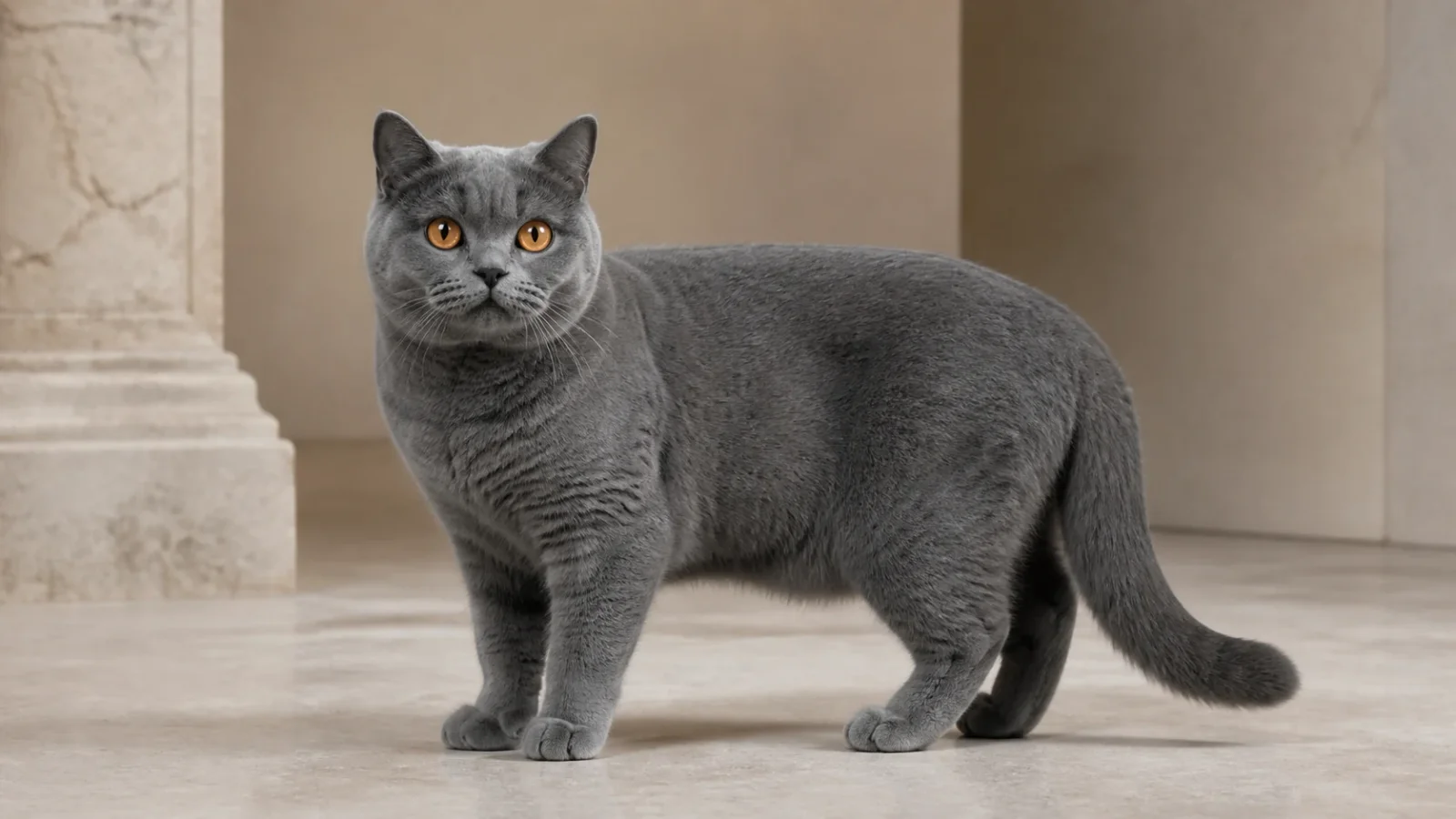
The British Shorthair is a medium-to-large, slow-maturing breed. Full physical maturity usually takes three to five years. Adult females commonly weigh about 3.6–5.0 kg, while adult males commonly weigh about 4.5–7.3 kg. A round head, broad chest, substantial frame and dense short coat create the familiar British Shorthair outline.
This guide covers the breed itself: history, the current CFA standard, coat, temperament, colours, health research and Singapore cat rules. Our British Shorthair kittens in Singapore page carries current kittens, prices and viewing information. Pedigree, microchip, vaccination and health-document details sit on our Pedigree & Health Standards page.

CFA allocates 35 points to the body, 25 to the head, 20 to the coat and 20 to colour.
From the English Shorthair to today’s British Shorthair
On 13 July 1871, the Crystal Palace in London hosted a cat show with 170 entries. Cats described as English Shorthairs were already part of the event. Best in Show went to a 14-year-old blue tabby shorthair female owned by Harrison Weir. Weir later developed early judging standards and helped establish the National Cat Club in 1887.
The breed population fell sharply during both world wars. Post-war breeders used Russian Blue, Burmese and Chartreux cats to rebuild genetic diversity. Persian cats contributed heavier bone, a rounder outline and a recessive longhair gene. That gene explains why two shorthaired parents can produce British Longhair kittens. Genetic testing can identify longhair carriers.
How the CFA scores a British Shorthair
The 2025–2026 CFA standard divides 100 points as follows:
SectionPointsBreakdownBody35Torso 20; legs and paws 10; tail 5Head25Muzzle and chin, skull, ears, neck and eye shape: 5 eachCoat20Texture, length and densityColour20Coat colour 15; eye colour 5
The torso alone carries 20 points, equal to the entire coat section. The breed outline depends on the full structure: round head, broad chest, powerful torso, straight legs, proportionate tail and springy short coat.
Head and profile: a broad nose with a gentle dip
The skull is round and massive, set on a short, thick neck. The forehead curves into a small flat plane at the top of the head. In profile, the nose is medium in length and broad, with a gentle dip and a continuous bridge. The nostrils remain visibly open from the front.
The chin lines up vertically with the nose and upper lip. The muzzle is well developed, with full, round whisker pads and a firm lower edge. Medium ears have broad bases and rounded tips. They sit well apart and follow the rounded contour of the head. The eyes are large, round, open, level and widely spaced.
CFA disqualifications include a definite nose break, narrowed nostrils caused by a shortened head, a wry jaw, poor dentition and malocclusion. A correct British Shorthair profile shows a medium-length broad nose and a gentle dip.
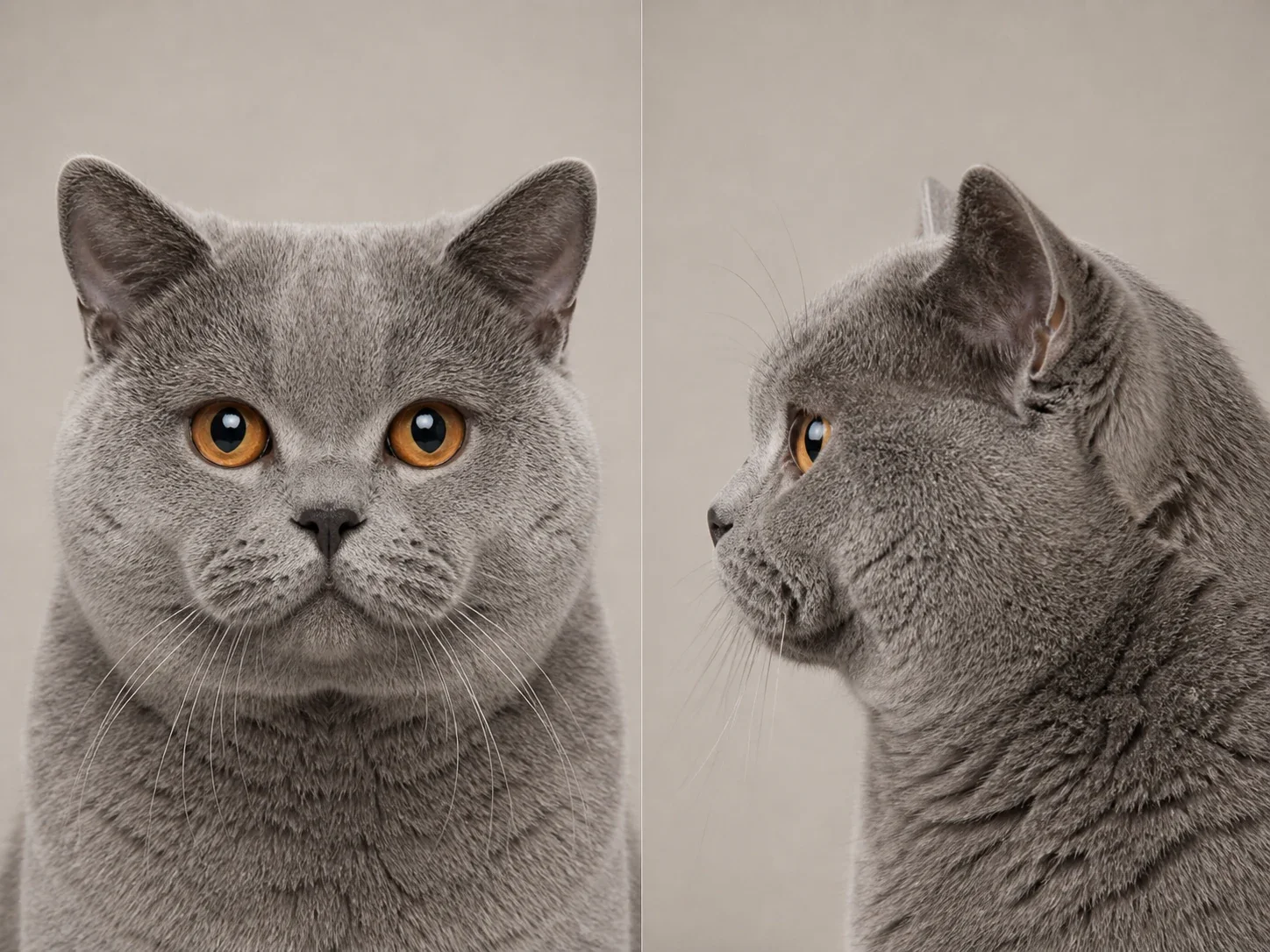
The CFA profile has a gentle nose dip, a firm chin and wide-open nostrils.
Body, legs, paws and tail
The body is medium to large, compact and powerful, with a level back and a deep, broad chest. Legs are short to medium in length, well boned, straight and proportionate to the body. Excessively shortened legs lose points. The paws are round and firm, with five toes in front and four behind.
The tail matches the body in length and proportion. It is thicker at the base and tapers slightly to a rounded tip. Tail defects are a CFA disqualification. In this breed, “compact” describes a strong, closely built body with straight, proportionate limbs.
Why the coat feels dense and springy
The coat is short, exceptionally dense, firm, crisp and resilient. When pushed against the direction of growth, it springs back into place. A long, fluffy, woolly or very soft coat with little resilience loses points.
The plush appearance comes from high density and springy hair. The current CFA coat classification is “not double coated or woolly”. GCCF describes routine maintenance simply as grooming during moulting.
What three to five years of maturity looks like
British Shorthairs usually reach full maturity between three and five years. Females are generally lighter. Mature males often develop fuller jowls, while chest width, head size and facial substance continue to develop through early adulthood.
Body weight combines bone, muscle, organs and fat in one number. A WSAVA body condition score of 5/9 has a light fat covering over the ribs, a visible waist from above and an abdominal tuck from the side. Muscle condition is assessed separately over the spine, shoulder blades, skull and hips. A cat can carry excess fat while also losing muscle.
British Shorthair temperament
British Shorthairs are commonly calm, patient and quiet, and many prefer sitting near their family to constant handling. TICA describes the breed as “four feet on the floor”: many individuals enjoy contact while keeping their feet supported. When lifted, support under the chest and hindquarters gives the cat a stable position.
GCCF also notes the breed’s awareness of household routines and its generally tolerant manner around other pets. Temperament varies between individuals. Our current British Shorthair profiles show each kitten’s observed activity and interaction style.
British Shorthair colours and patterns
Blue is the breed’s best-known colour. British Shorthairs also appear in solid, shaded, chinchilla, smoke, tabby, patched tabby, tortoiseshell, calico and bi-colour combinations. Registry names and colour codes vary.
Tipping helps separate shaded from chinchilla coats. In shaded cats, colour covers roughly one-third of the hair shaft. In chinchillas, it covers roughly one-eighth. Base colour, pattern and registry terminology then produce names such as golden, silver, blue golden, NY11, NY12 and NY25. Our Golden British Shorthair guide explains those codes in detail.
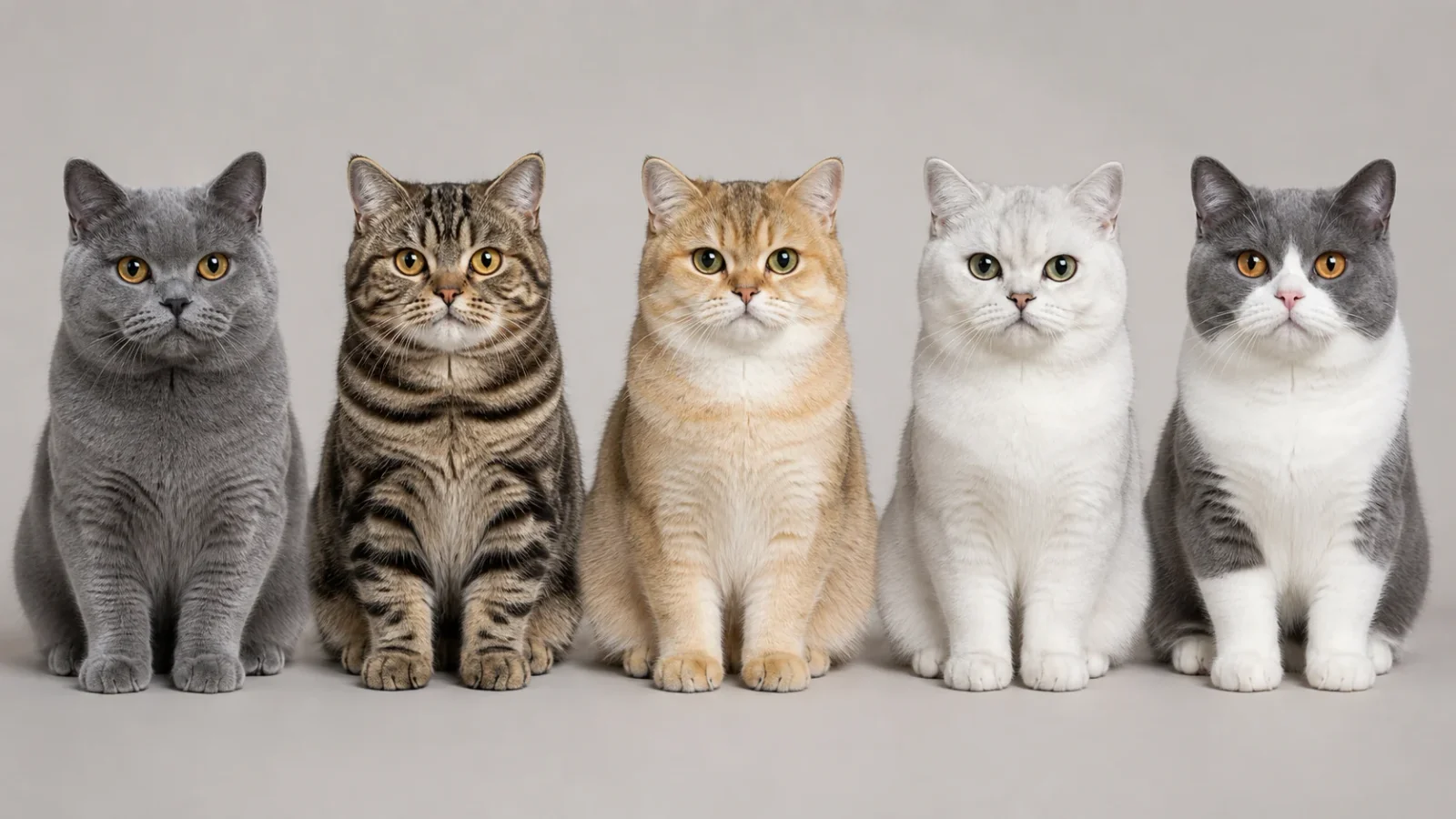
Left to right: solid blue, brown classic tabby, golden shaded, silver chinchilla and blue-and-white bicolour.
Hypertrophic cardiomyopathy in British Shorthairs
Hypertrophic cardiomyopathy, or HCM, thickens the heart muscle. Early disease can be silent.
A Danish screening study examined 329 British Shorthairs and classified 8.5% as HCM-positive. The result was 20.4% among males and 2.1% among females. These are figures from that Danish cohort; corresponding prevalence data for British Shorthairs in Singapore are unavailable.
Echocardiography measures ventricular wall thickness and chamber dimensions and records other structural and functional findings. The report date, examiner, cat’s name and microchip number connect the result to a specific parent cat. A DNA report covers only the variants named on that report.
HCM can progress to congestive heart failure or arterial thromboembolism. Persistent open-mouth breathing, laboured breathing, collapse, or sudden severe pain, coldness or weakness in the hind legs requires immediate emergency veterinary care.
Polycystic kidney disease and the PKD1 variant
Polycystic kidney disease, or PKD, causes fluid-filled cysts to form in the kidneys. A 2015 case series described four affected British Shorthairs. Two carried the Persian-associated PKD1 variant. The finding confirms that this variant has appeared in some British Shorthair lines. Breed-wide prevalence remains unknown.
A PKD1 report identifies the test, laboratory, sample date, cat, result and interpretation. A negative result means the laboratory did not detect the listed PKD1 variant in that submitted sample. GCCF maintains PKD evidence routes for active breeding cats, including qualifying negative results and specified proof through parents.
Why blood type matters in this breed
A 1999 UK study included 121 British Shorthairs: 39.7% were type A, 58.7% type B and 1.6% type AB. In the non-pedigree cats from the same study, 7.9% were type B.
Blood type guides donor selection and cross-matching for transfusions. It also affects breeding. When a type B queen mates with a type A tom, type A or AB kittens can absorb maternal antibodies from colostrum and develop neonatal isoerythrolysis. Parent blood types therefore affect both mating decisions and the care of newborn kittens.
British Shorthair lifespan: what 9.58 years and 20 years describe
SourceFigureMeaningTICA breed profile12–20 yearsBroad breed lifespan rangeGCCF breed profile14–20 yearsBroad breed lifespan range2015 UK primary-care study11.8 yearsMedian age at death in the study sample2024 UK VetCompass life table9.58 yearsLife expectancy at birth, calculated from 2019 clinical records
These figures answer different questions. The TICA and GCCF figures are broad lifespan ranges. A median of 11.8 years means that half of the recorded deaths occurred above that age and half below it. The 9.58-year figure is life expectancy at birth in a UK veterinary dataset, with a 95% confidence interval of 8.73–10.43 years.
Singapore cat licensing and ownership limits
Every pet cat in Singapore is covered by AVS licensing rules. A licence is tied to the cat’s microchip. First-time cat or dog licence applicants complete a one-time online pet ownership course.
HDB flats permit a maximum of two cats and one approved small-breed dog per residential unit. Private premises permit a maximum of three cats or dogs in total, including any combination of the two. Estate by-laws and tenancy terms can add separate conditions.
The pet-cat licensing transition period ends on 31 August 2026. From 1 September 2026, keeping an unlicensed pet cat is an offence. Cats owned before 1 September 2024 that exceed the normal residential limit can remain under the transition arrangement when licensed by the deadline.
Licence conditions cover a safe home environment, protection from falls and physical control in public. AVS gives a secure carrier or a harness as examples of public-space control. A pet licence records the animal with AVS; permission to keep a cat at a specific property still comes from HDB or the relevant estate management.
Continue on NekoTown
British Shorthair kittens in Singapore: current kittens, pricing enquiries, colours, viewing and the purchase process.
Pedigree & Health Standards: pedigree, microchip, vaccination, veterinary and parent records, organised by the documents available for each cat.
Golden British Shorthair guide: golden, silver, NY11, NY12, NY25 and related colour terms.
Book a kitten viewing: viewing appointments at 599 Geylang Road.
British Shorthair Singapore FAQ
How does CFA allocate the British Shorthair’s 100 points?
Body receives 35 points, head 25, coat 20 and colour 20. The torso alone receives 20 points, equal to the entire coat section.
Is the British Shorthair a double-coated breed?
The coat is short, exceptionally dense, firm, crisp and resilient. The CFA 2025–2026 coat classification is “not double coated or woolly”.
At what age is a British Shorthair fully grown?
Full maturity usually takes three to five years. Adult males often develop more prominent jowls, while females are generally lighter.
What did the Danish HCM study find?
Among 329 screened British Shorthairs, 8.5% were classified as HCM-positive. The figure was 20.4% in males and 2.1% in females. The results belong to that Danish screening cohort.
What information appears on a PKD1 report?
A report identifies the test, laboratory, sample date, cat, result and interpretation. A negative result means the laboratory did not detect the named PKD1 variant in that sample.
Why record a British Shorthair’s blood type?
In a UK study of 121 British Shorthairs, 58.7% were type B. Blood type informs transfusion compatibility and cross-matching. In breeding, it identifies pairings associated with neonatal isoerythrolysis.
Is 9.58 years the average lifespan of every British Shorthair?
The 9.58-year figure is life expectancy at birth from a 2024 UK VetCompass life table. TICA and GCCF give broader breed ranges of 12–20 and 14–20 years.